
Certification Process
Certification Process
The process for gaining ISO certification is straightforward and follows a consistent approach for all management systems standards, including ISO 9001, ISO 14001, ISO 45001, ISO2000-1, ISO22301, ISO 27001, ISO27701, ISO13485 and ISO20000-1.
Three steps to certification
Application
To start the process, the first step is completing the Application Form. This form provides all the information required about your business so we can determine the scope of certification and calculate the audit timing and coverage.
Assessment
The Assessment stage is a straightforward process which consists of two mandatory visits that form the Initial Certification Audit. The Stage 1 and Stage 2 audits that form this process are designed to cover both the preparedness and implementation of your management system. At any assessment stage, there may be a requirement for an observer, accreditation assessor or trainee auditor to attend, there will be no cost for this)
Certification
A Certificate is issued after the positive completion of the Initial Audit process. Certification is maintained through a programme of annual or six-monthly surveillance audits and then a three yearly recertification audit, as shown below.
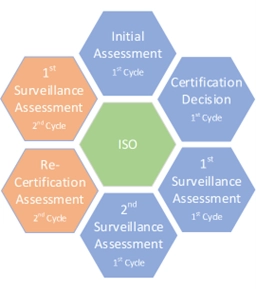
The Assessment Process
Stage 1
The purpose of this audit is to confirm that your organisation is ready for assessment.
The assessor will:
- confirms that the management system meets the requirement of the Standard
- confirm its implementation status
- confirm the scope of certification
- check legislative compliance
- produce a report that identifies any potential non-compliance or opportunities for improvement and agree a corrective action plan if required.
Stage 2
The purpose of this audit is to ensure that the management system fully conforms to the requirements of the chosen Standard in practice.
The assessor will:
- undertake simple audits of the processes and activities defined in the scope of certification
- document how the system complies with the Standard by using objective evidence
- report any non-compliance(s) or opportunities for improvement
- produce a surveillance plan and agree a date for the first annual surveillance visit
Certification
Successful completion of the Initial Assessment process, with no findings or non-conformities, will result in the issuance of a Certificate, valid for three years, subject to annual surveillance.
Note:
If the assessor identifies any major non-conformances, certification cannot be issued until correction and corrective action is taken and verified. Accreditation requirements stipulate that if this is not completed within six months, then certification cannot be recommended without a further Stage 2 assessment.
Surveillance
Surveillance audits are undertaken periodically to ensure that compliance to the chosen Standard is maintained throughout the three-year certification cycle. At any assessment stage, there may be a requirement for an observer, accreditation assessor or trainee auditor to attend, there will be no cost for this)
The frequency and duration of surveillance is dependent on factors including:
- size and structure of the organisation
- complexity and risk of activities
- number of management system standards included in the scope of certification
Recertification
Recertification audits are conducted prior to the end of the 3-year certification cycle to confirm the effectiveness of the management system in its entirety over the cycle. Once the Recertification has been successfully completed then new certification can be granted based on the expiry date of the existing certification.
Transfers
The certification services of 3core² are carried out systematically, in line with the documented policies, procedures and methodologies. We want to work with our clients to ensure ISO certification enhances their businesses and to help them achieve real commercial benefit from their management system investment.
Accredited certification can be transferred independently or as integrated management system certifications for single or multiple sites.
The transfer process does have a few formalities which maintain the integrity of the certification during transfer. We will need a copy of your current certificate of registration and latest audit report(s) going back to your organisation’s last certificate decision.
Transfers can be performed at any time; all 3core² need to ensure is continuity in compliance. With three simple options, the choice of which is based on your current certification cycle, there are many advantages in considering a move to 3core².
After successful completion of the transfer process, we will issue a Certificate of Registration with the same validity as your previous certificate, ensuring that your registration continues uninterrupted.
Appeals
If a Company feels that the findings of the Audit Team, or a decision taken on the certification, are not appropriate, the following procedure should be followed:
The Company shall contact the 3core² Office within 21 days of the Audit and advise of the intent to Appeal against the findings of the Audit Team. Each appeal shall be logged and 3core² Certification are committed to acknowledge the receipt of each appeal within 24 hours.
- Unique reference number
- Client number
- Date and time
- Customer and contact name
- Reason for appeal
If you wish to make an appeal, please contact us at: info@3core2.co.uk
Complaints
Each complaint shall be logged by the person receiving it. Complaints shall be logged and 3core² Certification are committed to acknowledge the receipt of each complaint within 24 hours.
If you wish to make a complaint, please contact us at: info@3core2.co.uk
Suspension & Withdrawal of Certification
Suspension
- The client’s management system has persistently or seriously failed to meet certification requirements.
- The client’s management system is no longer compliant with the certified standard(s).
- Failure to allow surveillance or recertification audits.
- Non-payment of invoices.
Withdrawal
- The client is no longer in business.
- The client has voluntarily requested withdrawal.
- Failure to address actions required to lift a suspension.
- Persistent or serious failure to meet certification requirements.